
“It’s tough to make predictions, especially about the future.” — Yogi Berra
Dear Clients,
As we move into the final quarter of the year, Yogi Berra’s words seem particularly fitting.
We’ve seen strong corporate earnings, continued market growth, geopolitical uncertainty, and unexpected turns in inflation and interest rates. Through it all, the markets have reminded us of something important: the future is difficult to predict, but we can prepare for it.
I wanted to share a few observations about where things stand, what we’re watching, and how we’re positioning your investments.
Strong Earnings, but Expectations Matter
Corporate earnings have been remarkably strong. Third-quarter earnings growth for the S&P 500 is estimated at nearly 30%, potentially marking the third consecutive quarter above 25%. For perspective, the long-term average is just under 10%. (1)
That’s impressive, but strong earnings don’t necessarily mean equally strong investment returns ahead.
The forward price-to-earnings (P/E) ratio, based on next year’s earnings estimates, is 19.1, below its five-year average and roughly in line with its ten-year average. (1) The longer-run P/E average is about 16. (2)
In other words, stocks remain expensive by longer-term historical standards, even if valuations have eased relative to some recent periods.
We’re also entering the fourth year of the current bull market. We haven’t experienced a 5% market correction this year, which is unusual. According to Schwab, declines of 5% or more occur in about 94% of years since 1974; 10% corrections occur roughly every 1.6 to 2 years, and 20% bear markets about every 4 to 5.6 years. (3)
These declines can be uncomfortable, but they are a normal part of investing.
Market declines are not necessarily a sign that something is wrong. BlackRock’s long-term assumptions suggest annualized S&P 500 returns below 9% over the next decade. (4) The historical average is approximately 10%. (5) These are assumptions, not predictions, and will change as conditions evolve.
Our approach remains focused on preparing for a range of outcomes rather than relying on any single forecast.
Investor Sentiment
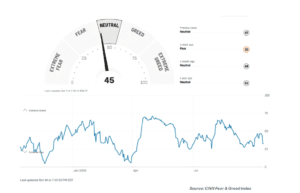
Investor sentiment has shifted from extreme fear around the start of the conflict in Iran toward a more neutral outlook, as illustrated by the CNN Fear & Greed Index below.
That shift is a useful reminder of how quickly headlines can influence our emotions. Investing is a marathon, not a sprint.
Inflation, Interest Rates, and the Conflict in Iran
When the conflict began, there were concerns that disruptions to the Strait of Hormuz could have severe consequences for the global economy. Eight months later, the global economy has proven more resilient than many expected.
Oil shipments through the Strait have returned to near-normal volumes, although damage to refining facilities has created shortages in diesel and other important products. Diesel prices in the U.S. have risen from approximately $3.75 per gallon a year ago to more than $6.00, contributing to renewed inflationary pressure. (6)
While inflation remains well below its 2022 peak, it has been persistent enough to change the Federal Reserve’s direction.
At the beginning of the year, markets expected three quarter-point interest-rate cuts. Instead, the original draft reports a rate increase in September and suggests another quarter-point increase may follow in December. (7)
It’s a meaningful reversal, and another example of why we don’t build investment strategies around economic predictions.
Elections and Market Uncertainty
With the midterm elections approaching, political headlines will likely become more prominent.
The consensus forecast for the House of Representatives projects that Democrats could gain approximately six House seats, bringing them to 220 and potentially giving them a majority. (8) Of course, election outcomes remain uncertain.
If Congress becomes divided, we could see a period of political gridlock. Historically, divided government has sometimes coincided with positive equity returns, partly because major policy changes can become more difficult to enact. (9)
Still, political outcomes alone are not reliable predictors of investment returns.
Our focus remains on the underlying economy, corporate earnings, valuations, and the long-term opportunities available to investors, regardless of which party is in power.
Artificial Intelligence: Opportunity and Uncertainty
Few developments have generated as much excitement and concern as artificial intelligence.
Some see extraordinary opportunities for productivity, healthcare, and economic growth. Others worry about the consequences for employment and society. The reality is that we don’t yet know how this technology will reshape our world.
What we can see is that AI is already changing how businesses operate, helping advance medical research, and creating new industries. Its influence will likely extend well beyond the technology sector.
As investors, we want to participate in long-term innovation without allowing enthusiasm for any one technology or industry to overshadow the importance of diversification.
Portfolio Positioning
In fixed income, we continue to favor higher-quality bonds with less sensitivity to changes in interest rates. We believe this is a prudent position given the current economic environment.
We also continue to hold investments in gold and infrastructure as part of our broader diversification strategy.
Earlier this year, we increased exposure to international markets, including both developed and emerging economies. Innovation and economic opportunity are not limited to the United States.
These decisions reflect our focus on balancing opportunity with risk while keeping your long-term financial goals at the center of our investment decisions.
Keeping Perspective
Markets will always give us something to worry about, whether it’s inflation, elections, geopolitical events, or the next technological breakthrough. And while the headlines change, the principles of successful long-term investing remain remarkably consistent.
We can’t control the markets or predict every turn. What we can do is remain diversified, manage risk thoughtfully, and make decisions based on your long-term needs rather than short-term emotions.
That’s where our attention remains.
Thank you for the trust you place in us. We appreciate the opportunity to be part of your financial life and look forward to continuing our work together.